The Breeders Play to a Bunch of Breeders: Live at The Bell House, 3/29/13

on Mar 31, 2013

A warmly rapturous opening applause.

Electrified yelps of excitement only minutes later, after the Deal sisters and Co. started from the start with a brick-solid charge through "New Year," when Kim started doing the 'awoooha' opening of "Cannonball" into the white crushed-paper-cup-looking thing attached to her mic.

Later, a man in the crowd yells, "Thank you for doing this!"

Later still, in response to a few audience requests, another yells, "Play whatever you want!"

Tickets for the show had sold out quickly -- within somewhere between two and five minutes, depending on where you read it -- many weeks before, but, even with all that time to get used to the idea of the Breeders reuniting to play Last Splash live, it was still as if the audience couldn't believe its good luck. Twenty years later, one more chance to pogo to "Divine Hammer."

Not that everyone at the Bell House was old enough to qualify for an Alternative Nation lifetime membership. Last Splash's saturated green and red cover may have been a ubiquitous fixture of a specific long gone time and place, but its songs, like most of those graced by Kim Deal's own particular Midas touch from the '80s and '90s, have aged well. Or, really, the album hasn't aged much at all. Its let's-try-anything energy gives it a perpetual youthfulness. In 1993, a life raft adrift in a sea of self-serious grunge, Last Splash was a rare thing; a predominantly fun rock record that also went on to sell over one million copies.

Doesn't look a day over 10 years old
Watching them resurrect the album from start to finish wouldn't have been nearly as rewarding if it were merely a rote recitation. Fortunately, it was the opposite of the monastic backstage vibe seen on loudQUIETloud, the Pixies reunion tour documentary. It felt more like being privy to, say, their third practice back together: some parts here and there were maybe still a little loose in a good way, but overall things were really starting to click, and you could tell they were excited simply to be on the same stage with one another again. The palpable joy and freewheeling banter (Kim confirming with bassist Josephine Wiggs that she could have walked to the gig from her house) was underscored by the pains they went through (swapping instruments for certain songs, having to get a new minimoog for just one bit) to faithfully reenact the record as it was made. The attention to detail showed how much affection they still have for the music.

They don't always ban photography
They must have been taping the show for historical purposes, given all the signs posted insisting that photography would be punished by immediate ejection. After seeing a couple of  iPhone-tographers get shut down, this writer went with the rules, hence none of the blurry from-the-back-of-the-room pics you'd normally find here. However, bigger, or braver, fish took pics: here and here, for two. It should make a great DVD whenever it comes out. Hopefully they will keep in all the songs from Pod (their debut, which is every bit as good as its successor) that made up the extended encore.


Here is the exact moment I decided to love the Breeders: It was the fall of 1993. I was in the car with my dad, driving west along Roxbury Ave. up the hill to our house in Arbor Heights (the name sounds fancy, but the neighborhood was, and is, not) in ass-end of West Seattle. "Cannonball" came on the radio. As we ambled toward the stoplight at the intersection of 35th, my dad made the very fatherly statement, "This isn't even music." 

The thing is, my dad rarely said that kind of thing. Thanks to him, the first music I remember hearing as a child was the Clash and the Smiths. He bought Nevermind when it first came out, as well as Alice in Chains' Dirt. In fact, two years earlier, when we were driving around the San Juan Islands on a heat-baked family weekend trip in the summer of 1991, he cranked up "Man in the Box" on the car radio after I complained that it wasn't musicHis positions had never left me much to rebel against, so I had to take it where I could get it. Asserting my fandom, it might have been the first time I had listened to "Cannonball" all the way through. 

A parting thought: Pacer, the one and only album released by the Amps, is ripe for rediscovery. A temporary outlet started as a way to keep active while the Breeders were short a couple of members, Kim Deal's 1995-96 endeavor received a mixed reception in its day. For an artist from two high-profile bands notable for sounding chaotic and spontaneous, the Amps still managed to come off as a little bit more chaotic and spontaneous. "Tipp City" made it on the radio, but it should have been bigger than it was. Now that all things 'lo-fi' and 'side project' are held in generally higher esteem than they perhaps once were, it might not be a bad idea for 4AD to at least consider a similar 20th anniversary re-release in 2015...


Why so sad?

on Mar 20, 2013
Despite it's name, it turns out that Beach House's "Wedding Bell" would not be a particularly appropriate tune to play at, you know, a wedding. I came by this little nugget of insight a few weeks ago, near the beginning of my (still ongoing) quest to put together some songs to be played at my own wedding.

It started out well enough, pretty instrumental for a processional, check. Background-y reception dinner time stuff, check. Crowd pleasing stuff to get people dancing, check. Selections to be played after the parents and relatives retire for the night, check.

The trouble came when my fiance and I decided that, yes, we would do the whole first dance thing. "Great" I thought, "a chance to pick more songs!" I was so confident that we'd have a hard time narrowing down our choices, I convinced my very patient betrothed to conduct a March Madness style song elimination bracket to choose a winner from among the pool... and that's how I found myself searching for "Wedding" in my iTunes library as a place to start.

I was initially hopeful when I saw "Wedding Bell" bubble up in my search results. We both like Beach House quite a bit, and upon first inspection it seems like it'd be nice to dance to. Then I listened to the lyrics. Turns out this song has a little bridge where Victoria Legrand sings:

I
Enjoy 
Nothing
Ahhh

Whelp, that won't do. 

This little pattern repeated itself over and over: Think of a song we'd both like, put song on list, get excited, listen to song, realize lyrics are sad and/or full of f-bombs, cross song off list. Now I know why people phone this stuff in.

As I eliminated song after song, album after album, and band after band from consideration, I realized that I just didn't have much to choose from amongst my personal library. At some point, I started to wonder whether this was a personal problem. Is it that I have always disliked love songs but wasn't conscious of the fact until, at 33, I really needed one?

Then, I tuned on the bands. I mean, come on you guys. Shouldn't Songs of Faith and Devotion have one song that's just about, you know, that? Look. We'd dance to The National. We'd dance to Iron & Wine. We'd dance to Modest Mouse! All we needed was one good song about how one person loves some other person AND other person loves them back AND other person is not dead, with someone else, in prison, a zombie, etc.

Oh, Robert Smith definitely gets a point for "Lovesong", which he wrote  as a wedding present for his future wife and is great, it is way too upbeat to be considered first dance material.

How about this. If not a love song, how about just something generally happy that I can slow dance to with my bride? Great, expand the scope. Let's see... nope, not many songs to commemorate my marriage to here either. Like, hey Animal Collective! I hate single you guys out, but by now shouldn't you have accidentally written a song that meets that criteria?

Oh well, It's not all bad news. While the 64 song tournament was quickly cut to 32, then scrapped altogether, we did both eventually find a few good choices, and picked a clear favorite that we're both thrilled with. Once we get hitched in June, I'll reveal the winner, and discuss a few songs that didn't quite make the cut.

Night Falls on Hoboken, Part 1: Chelsea Light Moving at Mawell's, 3/2/13

on Mar 4, 2013
This past Saturday, Hoboken, NJ, officially celebrated St. Patrick's Day. The 'zombie' thing is played out by now, but it's hard to conjur a more apt description of the experience of walking up Washington Street from the PATH train station to Maxwell's than to compare it to the scene in Shaun of the Dead where the gang have to pretend to be zombies as well in order to get down the street safely. Adrift in a swirling bright green haze of staggering boys, collapsing girls, and the dim bellowing of quite-uncalled-for language -- muted only slightly by a tranquil fat-flaked snowfall -- I recalled the first piece of advice I was ever given in New York, by the family member I was visiting back in 1999: "don't make eye contact with anyone."  

If you were hoping for good pics of the show, please see Brooklyn Vegan
Not since the days of Jawbreaker has it been more endearing to see a frontman wearing his own band's T-shirt on stage. Speaking of, the punk and hardcore turns of Chelsea Light Moving shouldn't be much of a surprise coming from a man who immediately changed into a Void T-shirt after his own wedding ceremony. If anything, the prevalence of those turns has been a little overstated. There's the Germs cover, and "Lip," but even in those there are equal measures of appreciation for history and humor in, say, the jabbing riff and repetition of "too fucking bad/too fucking bad." As welcome as a whole album's worth of "Winner's Blues"-type quiet would be, it's a relief that Moore seems still a ways off from going soft.

Live, Chelsea Light Moving sound like a mohawked cousin of Psychic Hearts, Moore's rapidly written and recorded, and rightfully revered, 1995 solo album, which was given an excellent 'Don't Look Back' performance at the first All Tomorrow's Parties in the US a few years ago. When the band encore later with "Staring Statues," a highlight from that album, it fits in to the set seamlessly. That there was a time when "Ono Soul" got played on major FM radio stations seems absurd now, but 98% of the audience at Maxwell's surely remembers that time vividly. 

It's best to pretend that we were taking artsy photos on purpose
One of the funnier aspects of the show is that, for a punk band "from New Jersey" (as Moore deadpans at the start) that's premiering their debut album in a small club, there's a beyond-impressive wealth of talent and experience between the Moore, bassist Samara Lubelski, guitarist Keith Wood (Hush Arbors), drummer John Moloney (Sunburned Hand of the Man). Notably, the veteran Lubelski released one of the finer albums of last year, Wavelength.

Late into the show, Moore becomes talkative, and, awesomely, it diverges into what might be the closest thing to a VH1 Storytellers episode that we'll get out of him - though there's always hope. A guy in the audience calls out to Moore that he owes him a tape of a show from fifteen years ago. After a short clarifying back and forth, Moore recalls the episode and the exact Feelies show in question, and tells the guy to send him his email and he'll finally make good on the promise.

The mood even gets a bit wistful when Moore gives a shout out to Bob Bert, a longtime Hoboken resident and the drummer for Sonic Youth in the formative early-to-mid 80's years from Confusion is Sex to Bad Moon Rising, who is in the audience. He segues from there into an anecdote, also told in the Sonic Youth biography Goodbye 20th Century, about a 'wanted' flyer that the band posted up on St. Mark's Place back in the day that said "Sonic Youth Needs Drummer," on which someone had crossed out "drummer" and written "ideas." It was a jarring reminder of who we were watching: a legend with little left to prove, but still hungry all the same.
 

 Coming soon-ish: Night Falls on Hoboken, Part 2: Yo La Tengo in Berlin...


ECSTATIC PIECES: Laurel Halo, Julia Holter, Daniel Wohl, with Transit, at the Merkin Concert Hall, 2/23/13

on Feb 26, 2013


This year's Ecstatic Music Festival in New York is now in mid-stride, and will continue through March 21st. Originating waaay back in 2011 at the hands of the Kaufman Music Center, the festival has in its nascency already played host to probably at least half of the artists you would expect to show up at a festival that proclaims itself to be "at the nexus of New York City's vibrant 'indie classical' scene." Nico Muhly, Owen Pallett, Nick Zammuto, Sufjan Stevens, Merrill Garbus, Dan Deacon, Oneida, and the Mountain Goats, are just a few of the participants from the past two years. This year's line-up is equally both exceptional and of-the-moment. For one of the more telling examples, take the pieces written and performed collaboratively by Laurel Halo, Julia Holter, and Daniel Wohl, with Transit, last Saturday night at the Merkin Concert Hall.

This picture was not supposed to have been taken. Please don't tell the folks at the Merkin.
The fusing of the old and the new in music doesn't always go smoothly. Think of all the bad-to-worse pop acts in the late 90's that were attributed with combining rap and rock 'n' roll by paying a dude to stand off to the side scratching a record on a turntable just for the sake of making the record-scratch sound. The 1970's and 1980's were especially fruitful decades for traditional guitar/bass/drums ensembles to explore and introduce some new space-age synth or other device that they bought on sight while tore-up on some drug-fueled spree after finally cracking the the Top 10 singles charts, or whatnot. There have certainly been a number of successful examples of technology being expertly woven into songs based in more "organic" instrumentation -- the Beach Boys' use of the theremin in "Good Vibrations" immediately comes to mind. From Kraftwerk to Autechre, though, oftentimes the finest examples of a kind of 'way forward' for music have often long been to go full-robot...

This picture was okay to take, if not near as interesting.
...which is part of why the more recent successes of 'cyborg'-style compositions have been so encouraging, and Saturday's electro-chamber-music concert should be held up as just such a success. Halo, Holter, and Wohl provided the various keyboards, wire-sprouting electronics, and occasional vocals. Halo's and Holter's voices, sometimes alone and sometimes intertwining, were paired well, though there still seems to be something slightly odd about watching a person sing into a mic while sitting down behind a desk and computer (surely just a generational issue). Transit, meanwhile, provided the cello, violin, clarinets (bass and regular), pianos (grand and toy), and an array of percussion. One can reasonably guess which side carried more of the atmosphere and which brought more of the melody, but one of the more impressive accomplishments of the pieces they performed was how evenly those duties were actually split over the course of the two pieces that comprised the first half of the performance, and the longer final piece that balanced it out.

The Merkin Concert Hall is made of loads of very nice wood.
 One of the most compelling passages of the night came about halfway through that final piece, when pianist David Friend was isolated to wrench out a part seemingly structured (in an appropriate turnabout) to mimic that kind of fractured or chopped-up effect that has been increasingly prevalent in strains of electronic music since as far back as the early days of the aforementioned Autechre, and even before that. Watching Friend's intensity was a reminder that it's one thing to program a part like that, it is another thing to play it on an instrument in real time, which requires the focus to work against any inherent inclination, of the mind and/or the body, toward finding a rhythm. Friend didn't hit a bum note. One would have been hard-pressed to have found a bum note anywhere in the room that evening.

The pieces were commissioned for the festival, and the whole of the event brought to mind the comparative short-term and long-term cultural values of live performances versus recordings. Fortunately, they recorded the whole thing. Whatever 'indie classical' means now, or will come to mean later, more like this will always be welcome.      


Top 12 Albums with Moody Couples Holding Each Other on the Cover

on Feb 13, 2013

On February 14th, 1884, when Teddy Roosevelt was in his mid-20's, his wife and mother died within hours of each other. So, first off: we hope that your Valentine's Day will go better than that today. Chances are that it will. 
But, honestly, you don't want to have too nice of a Valentine's Day, do you? There's nothing cool about being happy in love. For example, unshackled single folk have all the best V-Day activities: 'love sucks' DJ nights, 'love sucks' comedy shows, 'love sucks' speed dating, etc. The concept that love sucks will never go out of style. Meanwhile, those who are happy in love can barely manage to change out of sweatpants for the occasion, and spend the night eating lumps of processed sugar from a cheap cardboard heart, sprawled out on some tacky bearskin rug, getting singed by sparks from a smoldering Duraflame log, all the while reading inane sex scenes from lesser Nora Roberts novels aloud to each other. That doesn't sound very rock 'n' roll at all, does it?? In order for love to be cool and artistically viable, or even merely be interesting, it has to be fraught, tumultuous, strained...


12:  The Soft Boys  -  Underwater Moonlight


Take these two creepy fake people, who are having a frowny and shoeless picnic on a bunch of cold jagged rocks. It would not be rock 'n' roll if they were smiling and sitting in a park...but it might actually be creepier...


11:  The Spinanes  -  Manos


Why are these two having a rough time? Possibly because the dude's hands smell bad. But having smelly hands and being upset about it is all part of rock 'n' roll.


10:  David Cross  -  Shut Up You Fucking Baby!


This woman needs a hug because she listened to this entire comedy album and didn't hear a single actual joke, only Bill Hicks-ian rants. But that's because actual jokes were not rock 'n' roll during the Bush years.


9:  Woodstock Original Soundtrack


This couple are having a bad trip because after the brown acid wore off, and they stopped staring at their lighters, they realized everyone was washing up and relieving themselves in the same pond. Really though, bathing in filth is practically the definition of rock 'n' roll.


8:  Dirty Dancing Original Soundtrack


Where there's smoke there's fire, and where there's forbidden love there's forbidden dancing. All the happy couples in this movie? A bunch of saggy ballroom-dancing square pegs.


7:  Eric's Trip  -  Love Tara


You can't see their faces, but you know these two are moody because of the black-and-white, and also it is the 1990's...


6:  Boards of Canada  -  Twoism


...and these two are moody because they can't make out, due to their retro-ass Steampunk astronaut helmets...


5:  Blur  -  Think Tank


...and these two are moody because they also can't make out, due to their retro-ass Steampunk SCUBA helmets.


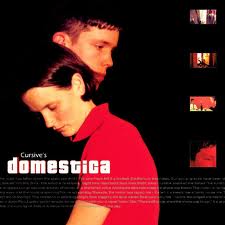
4:  Cursive  -  Cursive's Domestica


These two are moody (the girl might just be sleepy?) because no one understands teenagers. Especially teenagers.


3:  Placebo  -  Sleeping With Ghosts


These two are moody because that's just how the vibe goes when you hook up with a ghost...


2:  Blue Hawaii  -  Untogether


...even if both parties are ghosts, apparently. 'Haunted Domestica' doesn't look any cheerier than the skin-bag version. But the pained dynamic between this pair of poltergeists has nothing on these next two...


1:  David Bowie and Mick Jagger  -  "Dancing in the Street"


Yes, on the surface it would seem that everything about this marvelous song -- and its equally marvelous video -- is a toe-tappin', jumpin'-and-a-skippin' good time. But right beneath that surface is a clear underlying torment between Bowie and Jagger (probably because they can't jump each others' bones right there on camera), which the cover of the record bears as well. That's art, folks!

Happy Valentine's Day!


Honorable Mention:  Smashing Pumpkins  -  Siamese Dream


Somehow, these two happy children are completely rock 'n' roll. Only Billy Corgan at the very top of his game could get away with such a thing.


The Mystery of My Bloody Valentine's Song Titles: Solved

on Feb 6, 2013


Can it be any coincidence that within mere days of the release of one of longest-anticipated albums of all time by one of the most enigmatic songwriters of the modern era, a group of mathematicians hit upon the largest prime number yet found? The universe works in mysterious codes. 

As this week has worn on and we’ve begun to really settle in with mbv (or m b v, if you prefer) -- the new twenty-one-years-in-the-making My Bloody Valentine album -- two questions have never strayed far from our minds.

1) How is it going to feel when we’re creeping into our fifties and the next My Bloody Valentine album comes out?

2) Why are all those song titles so oddly vague?

A tunesmith and a wordsmith
Regarding the second question (only sweet and merciful fate can answer the first!), our initial thought was that Kevin Shields was naming the tunes using the same approach he takes to building them: detaching them from traditional structural constraints and expectations. With names like “is this and yes” and “she found now,” Shields evokes the half-remembered speech fragments of dreams, rendering the English language formless and hazy. The emphasis is on communicating ephemeral feelings and ambience, not putting forth anything as earthly as a specific idea.   

On second thought, though, we realized what was really going on: a secret word puzzle! Obviously, the words were intended to be rearranged into a different order, revealing a vital clue to a wondrous mystery. We’re not entirely certain we have the right answer yet, but we suspect we're getting close...

You wonder if who she sees tomorrow is only another new way. “Yes, and now this is found in you." I am nothing.


Lee always preferred Isn't Anything to Loveless
We have also deduced that the ‘2’ in the final song, “Wonder 2,” coming at the end as it does, is not actually a part of the word puzzle, but is a clue to where the lines come from: the long lost second novel of Harper Lee. Appropriately, inasmuch as it relates to the mbv saga, that novel was supposedly going to be titled The Long Goodbye

Chances are, once we have deciphered everything that Bilinda Butcher sings on the album, that will lead us to the exact spot where the novel is hidden, right down to the very brick in the giant fireplace we have to push to open the hidden vault.

The Long Goodbye, of course, is also (because, as any movie fan can tell you: that is how art works) one big secret code to something else...a map to the center of the Earth. Which is where they are going to hold ATP 2017. The journey is on!

Future site of ATP 2017

Some Great News For Lush's Legacy (and separately, also for MBV fans)

on Feb 3, 2013


WOW. Wow, wow, wow. We thought it was a miracle when Godspeed put out their first record in ten years, but this drought-end makes that hiatus look like a power-nap. We're still working through all of our many thoughts and feelings about mbv, but we will say this: we're pretty sure that My Bloody Valentine's first new album in over twenty years (and the first new material from Kevin Shields since his lovely contributions to the Lost in Translation soundtrack) was infinitely more worth the wait than Chinese Democracy. Personally speaking, now I just need the La's to finally put out that second album of theirs, and the teenage anglophile inside of me can die content. Sorry, that sounds sad and gross.

As it happens, right before the mbv-bomb dropped, we were mulling over one of their past contemporaries: Lush.
Lush, looking rather tough for a 4AD band.

Sparking up not long after the genre first burnt out, the slow-burning afterlife of shoegaze's influence has insistently drifted further and further on. The resurrection first rose up in earnest in scattered places. The Pacific Northwest was an especially fertile ground for the revival, with bands like Voyager One and The Melody Unit taking loose form just a year after, for instance, Lush, called it quits. Soon after that, there were so many neo-shoegazers in the land of evergreens that a local label started holding an annual covers-night bash, which came with accompanying compilation CDs. More and more bands since then have worn the influence to varying degrees, and "dream pop" -- a fittingly vague cloak that drapes over everything from Beach House to Wild Nothing -- has now made it the norm. This has, of course, come with the requisite amount of homage paid to that once-maligned first generation.  

This has happened to Ride a number of times, perhaps (unsurprisingly) more than any of their peers. There are groups out there called OX4 and Chrome Waves, and there is also Seattle's long-running Black Nite Crash, which took their name from a song title that Ride themselves nicked, from a chapter of Bob Dylan's crap 1960's experimental poetry novel Tarantula. Ride's Tarantula was also crap, save for "Black Nite Crash," one of its few redeeming songs. There is also London's Sennen, who get bonus points for naming themselves after one of the band's prettiest B-sides.  

The odds of two modern atmosphere enthusiasts sipping from the same ethereal soda can was inevitable. Last October, the tediously monikered Letting Up Despite Great Faults released their not-tedious album Untogether. Side note: it's safe to assume that more than one person saw this cover and figured 'Untogether' was the name of the band...and, really, it probably should have been. 

Letting Up Despite Great Faults
"Untogether," as a title, doesn't necessarily belong to Lush. It was also the title of a song from Belly's 1993 debut album Star. That itself is quite possibly not a coincidence. Given the two were contemporaries who shared more than a few fans, perhaps Tonya Donnelly was a fan of Lush's Spooky (released the year before Star) and decided to borrow the non-word. "Untogether" is also the name of a fantastic song by Women (RIP), but that song came out only a few years ago, and is thus not as likely to be borrowed from.

Also, given Letting Up Despite Great Faults' neo-shoegaze stylings, Lush is a more likely musical influence.    

Blue Hawaii
That influence isn't necessarily as clear with Canadian duo Blue Hawaii, who will soon release their own Untogether. Their vibe is dream-poppy enough, and I'm convinced that at least one of them owns Spooky, but if they said they hadn't listened to it since Freshman year, I'd believe them. Maybe in their case they did get the title from their countrymen, Women. Or maybe it was all chance, and they simply didn't check before naming their record. That wouldn't be surprising, given one member of Blue Hawaii's other band, Braids, also forgot to google before picking a name. 

The point of pointing out all of the above is -- aside from the human brain's predilection for pattern recognition -- that this is all excellent news for Lush's legacy. When Deerhunter released their own (less languid) "Desire Lines," the act of doing so articulated the growing influential value of Lush's work. This new development takes that validation a step further. Well, at least for most of that body of work -- from Gala to Split. Their last, Lovelife, will probably have to wait a while longer (for the inevitable Britpop resurrection) for ever-morphing public tastes to value its redeeming qualities.

To wit, by the late-mid-90's, the concept of Lush having much of any legacy was questionable. Lush were sideswiped, and then swept up, by the ascendance of Union Jack rock -- as were many of the Thames Valley flock. Catherine Wheel, whose Chrome remains one of the highlights of early-90's British rock, went grunge too late, before going Britpop too late. Slowdive -- now retroactively beloved as much as they were shunned at the time -- went further into space before moving on to other great things (Mojave 3). Ride's rapid decline from their first few glorious records to the dull Carnival of Light and the d.o.a. Tarantula, was especially disheartening to watch. Comparatively then, Lush managed their path through the changing fashion better than much of the rest.  Their rebranding even came with a new bright pink logo that combined Oasis' frame logo and Blur's circle logo.

UK bands have long been allowed to change their stripes between albums (the Beatles, Bowie, Blur), and Lush always put hooks and structures just underneath the delay and chorus pedals. Still, Lovelife was a bit of a stretch, and singles like "Ladykillers" and "500" primarily bore simple and immediate rewards. Droning on with shoegaze felt out of fashion in 1996, but, by the end of the following year, as Be Here Now bellowed "Iceberg, right ahead!" on the Britpop Titanic, "Single Girl" felt equally adrift. On the bright side, the world did get a duet between Jarvis Cocker and Miki Berenyi out of the whole ordeal, so there are no hard feelings.